
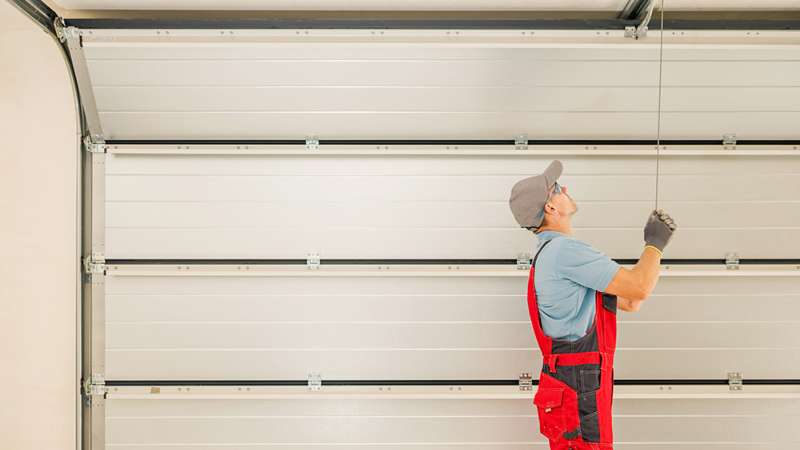
Most garage door problems don’t announce themselves with a sudden, dramatic failure. They start small — a slight grinding sound, a door that’s a little slower than it used to be, a spring that looks a little different but seems to be working fine. And because the door keeps opening and closing, homeowners put off calling anyone.
That delay is almost always a mistake. The five issues covered in this guide — failing installations, deferred repairs, outdated openers, worn springs, and damaged cables — all follow the same pattern: manageable and inexpensive early, costly and disruptive if ignored. Here’s what each problem actually looks like, what it leads to if left unaddressed, and what professional service resolves it.
Problem 1: Living With a Door That Was Never Quite Right
A surprisingly large number of homeowners are operating garage doors that were never properly installed in the first place. Misaligned tracks, incorrectly tensioned springs, undersized hardware, and poorly programmed openers are all common byproducts of DIY installations or low-quality contractors. The door opens and closes, so the problem goes unnoticed — but the system is working harder than it should on every single cycle.
What poor installation looks like in practice:
- The door vibrates or shudders noticeably during operation
- It’s louder than you’d expect from a relatively new door
- One side appears slightly higher or lower than the other when closed
- Springs have broken sooner than their rated lifespan
- The opener strains audibly when lifting the door
What professional garage door installation delivers:
A professional installation begins with accurate measurement of the opening — width, height, headroom, and side room — and selection of hardware correctly sized for the door’s weight and dimensions. Every component is installed to manufacturer specification: tracks set at the correct angle and plumb, springs tensioned precisely for the door’s weight, cables seated correctly on the drums, and the opener programmed with accurate force and limit settings.
A proper installation also includes a full safety inspection before handover — auto-reverse test, balance test, and photo-eye sensor alignment — so you know the system is not just functional but safe. The difference between a correctly installed door and a poorly installed one isn’t just noise and smoothness. It’s the lifespan of every component connected to it.
When installation service is the right call:
- You’re replacing an aging door and want a fresh, correctly configured system from the ground up
- A previous installation is causing recurring problems and component failures
- You’re building new or renovating and need a door fitted to a specific opening
- You’re upgrading to an insulated, energy-efficient, or aesthetically improved door
Problem 2: Small Issues That Are Quietly Becoming Big Ones
Garage door repairs are easy to defer because the door usually keeps working — just not quite as well as it did. A grinding roller, a bent track section, a hinge that’s worked loose, a bottom seal that’s cracked and pulling away from the door. None of these stop the door from operating. But each one accelerates wear on the components around it, and collectively they add up to a system that’s heading toward a much more expensive failure.
The most commonly deferred repairs — and what they lead to:
- Worn or broken rollers: Rollers that have developed flat spots or cracked wheels grind against the track on every cycle. Left unaddressed, they accelerate track wear and can eventually cause the door to jump the track entirely.
- Bent or misaligned tracks: A track that’s been knocked or pulled out of alignment causes the door to bind, jerk, or operate unevenly. The longer it runs out of alignment, the more damage accumulates on rollers, hinges, and the door panels themselves.
- Loose hinges and hardware: Every open-and-close cycle vibrates the hardware slightly. Over thousands of cycles, bolts and brackets loosen. Loose hinges allow panels to flex and shift, eventually cracking the panel or allowing the hinge to pull through entirely.
- Damaged panels: A dented or cracked panel isn’t just cosmetic. It can compromise the structural integrity of the door section, affect the door’s ability to seal, and in severe cases, cause the door to bind in its tracks.
- Failed weatherstripping: Cracked or missing seals along the bottom and sides allow drafts, moisture, pests, and in extreme cases, water to enter the garage. In attached garages, this directly affects the home’s comfort and energy performance.
What professional garage door repair delivers:
A professional repair service doesn’t just address the symptom — it assesses the whole system. A technician repairing a bent track will also check what caused the track to bend, whether adjacent components were affected, and whether the opener’s force settings need adjustment to compensate for any resistance the damage created. That whole-system perspective is what separates a repair that lasts from one that leads to another call three months later.
Signs it’s time to call for repair:
- Grinding, scraping, or banging sounds during operation
- The door moves unevenly, jerks, or hesitates
- Visible gaps between the door and the frame when closed
- The door reverses unexpectedly before fully closing
- You can feel drafts or see daylight around the closed door
Problem 3: An Opener That’s Behind the Times
Garage door openers have advanced significantly over the past decade. Older units — those installed before 2010 or so — often lack features that have become standard: rolling code security, battery backup, Wi-Fi connectivity, and quiet belt or direct drive operation. Homeowners with older openers are frequently unaware of what they’re missing until something fails or they discover a security vulnerability they didn’t know existed.
The hidden costs of an outdated opener:
- Fixed-code security risk: Openers manufactured before the mid-1990s — and some cheaper units well into the 2000s — transmit the same code every time the remote is pressed. This signal can be captured and replayed by anyone with a code grabber device, available online for very little money. Rolling code technology, standard on modern openers, generates a new encrypted code with every use.
- No backup for power outages: An older opener without battery backup leaves you unable to open or close the garage during a power outage. For attached garages, this can mean being unable to leave or enter your home, or unable to secure the garage after a storm.
- No remote monitoring: Modern smart openers let you see whether the door is open or closed from anywhere, receive alerts when it opens or closes, and close it remotely if you forgot. An older opener offers none of this visibility.
- Noise and vibration: Most older openers use chain drive systems that transmit significant noise and vibration through the garage structure. Modern belt drive and direct drive openers operate nearly silently — a meaningful quality-of-life improvement for garages adjacent to living spaces.
What professional garage door opener installation includes:
Professional opener installation covers selection of the correct drive type and horsepower for the door’s weight, mounting and wiring, programming of remotes and keypads, photo-eye sensor installation and alignment, and force and limit adjustment. A correctly programmed opener applies the right amount of force to lift the door without straining — a setting that amateur installations frequently get wrong, leading to premature motor wear.
Choosing the right opener:
- Belt drive: Quietest standard option. Best for garages adjacent to or below bedrooms and living areas.
- Chain drive: Most affordable and mechanically robust. Fine for detached garages where noise isn’t a concern.
- Direct drive: One moving part, exceptionally quiet and reliable. Premium longevity.
- Jackshaft: Wall-mounted, frees up ceiling space. Ideal for high ceilings or specialty storage.
Problem 4: Springs That Are Living on Borrowed Time
Garage door springs are the most mechanically critical — and most failure-prone — component in the system. They carry the full weight of the door on every cycle, and they have a finite, measurable lifespan. Yet most homeowners have no idea how old their springs are, what their rated cycle life is, or what warning signs look like before a spring fails.
Understanding spring lifespan:
Standard residential torsion springs are rated for approximately 10,000 cycles. One cycle equals one open and one close. A household that uses the garage door four times a day goes through roughly 1,460 cycles per year — meaning standard springs reach their rated life in about 6–7 years. A busy household with six or more daily cycles will burn through springs in 4–5 years. High-cycle springs rated for 25,000–50,000 cycles are available and significantly extend the service interval.
What happens when springs fail:
When a torsion spring breaks, it does so suddenly and loudly — a sharp bang that’s often mistaken for something else. The door immediately becomes effectively inoperable: without the spring carrying the door’s weight, the opener motor would have to lift the full load alone, which it’s not designed to do. Attempting to force the door open with a broken spring risks stripping the opener gears, snapping the cables, and bending the door tracks under the unbalanced load.
Warning signs before a spring breaks:
- The door feels heavier than usual when lifted manually
- The opener strains or slows noticeably when opening
- The door doesn’t stay in place when manually lifted to the halfway position
- Visible gaps or separation in the spring coils
- The door opens unevenly, one side higher than the other
Why spring replacement is always a professional job:
A torsion spring under full tension stores enough energy to cause severe injury or death if it releases uncontrollably during handling. Proper replacement requires specialized winding bars, a precise understanding of the correct turns of tension for the specific door weight, and experience with the process. This is consistently cited as one of the most dangerous DIY attempts a homeowner can make. The cost of professional replacement is modest — the cost of getting it wrong is not.
One important note on replacement timing:
When one spring breaks, replace both. If one spring has reached the end of its service life, the other is at the same point in its cycle count. Replacing only the broken spring means the second will likely fail within weeks or months — requiring another service call and another round of labor costs.
Problem 5: Cable Damage That’s Easy to Miss Until It Isn’t
Garage door cables are one of the least visible — and most important — components in the system. They run from the bottom corners of the door up through pulleys and connect to the spring system, transferring the spring’s stored energy into smooth, controlled door movement. Most homeowners never look at them closely enough to notice early warning signs, and by the time a cable fails, it does so without much warning.
How cables fail — and what each failure mode looks like:
- Fraying: Individual wire strands within the cable begin to break one by one. A frayed cable looks like a wire brush at the point of wear. Each broken strand increases the load on the remaining ones. Fraying is a predictable failure — catch it early and you replace a cable on your schedule. Miss it and the cable snaps without warning.
- Snap failure: A fully broken cable causes one side of the door to drop suddenly, leaving the door hanging at an angle. The door cannot be safely operated in this condition — the asymmetric load stresses the tracks, the opposite cable, and the spring system.
- Cable off the drum: Sometimes a cable doesn’t break — it slips off the drum it’s wound around, usually as a result of a spring failure or significant slack in the system. The cable coils loosely and can tangle in the mechanism, causing the door to bind or the track to be pulled inward.
- Corrosion: In high-humidity environments, the individual wire strands within the cable corrode over time, weakening the overall cable without any visible external fraying. By the time corrosion-related failure occurs, the cable may look intact but has lost significant tensile strength.
What professional garage door cable repair covers:
Professional cable repair involves removing the damaged cable, inspecting the drums and pulleys for wear or damage caused by the cable failure, installing a correctly sized replacement cable, re-seating it properly on the drum, and tensioning the system to restore correct balance. Cables are always replaced in pairs — if one has reached the end of its service life, the other is equally worn.
Signs your cables need immediate attention:
- Visible fraying, kinking, or rust on the cable surface
- The door hangs visibly lower on one side than the other
- Loose or coiled cable visible at the bottom of the door or along the track
- The door jerks or moves unevenly during operation
- The door dropped suddenly or won’t close evenly on both sides
Why These Five Services Are Connected
It’s worth understanding that these five service areas — installation, repair, opener service, spring replacement, and cable repair — are not independent of each other. They’re interconnected parts of a single mechanical system, and a problem in one area creates stress in others.
Consider how failures cascade:
- A spring that’s losing tension puts extra load on the opener motor, accelerating its wear
- A worn roller that’s grinding causes the door to bind, which puts asymmetric stress on the cables
- A misaligned track from a substandard installation accelerates roller wear, hinge stress, and cable drum friction simultaneously
- An opener set at incorrect force levels compensates for resistance by working harder — masking underlying problems until something breaks
This is why the best professional service visits don’t just address the one component that failed — they inspect the whole system, identify what caused the failure, and flag anything else that’s approaching end of life. That approach turns a reactive service call into an investment in system-wide reliability.
Quick Reference: Which Service Do You Need?
- Door was never right from day one, or you’re replacing an aging door: → Garage Door Installation
- Grinding, binding, drafts, loose hardware, or damaged panels: → Garage Door Repair
- Opener is old, unreliable, noisy, or lacks modern features: → Garage Door Opener Installation
- Loud bang, door won’t open, door feels heavy, or springs are 7+ years old: → Garage Door Spring Replacement
- Door hangs unevenly, cable looks frayed, or door dropped suddenly: → Garage Door Cable Repair
Final Thoughts
The common thread across all five of these service areas is timing. Every one of them is cheaper, simpler, and less disruptive when addressed early. The grinding roller that costs $80 to replace today is a derailed door that costs $400 to fix next month. The spring that costs $150 to replace proactively is a broken spring, a stripped opener gear, and a damaged cable that costs $600 to repair after the fact.
Your garage door operates roughly 1,500 times a year. It deserves more than benign neglect. Pay attention to how it sounds and moves, address issues when they’re small, and work with a professional who looks at the whole system rather than just the part that broke. That approach is what keeps a garage door system safe, reliable, and cost-effective for decades.